Orange Marketing
Some HubSpot updates arrive with keynotes and fireworks. This one showed up on page seven of the release notes.
Among all the shiny AI agents announced around UNBOUND last month, HubSpot rewrote how pipeline limits work. If you run Marketing Hub alongside Salesforce, this sneaky little change could save you money, and save you from asking finance to pay for a Sales Hub seat nobody will use.
What's the Big Deal?
Before this update, pipeline limits lived hub by hub. Deal pipelines were controlled by Sales Hub, and ticket pipelines by Service Hub. Sales Hub Free got you one deal pipeline. Starter got you two.
Now? You can now access one shared limit for your whole portal, set by your highest subscription tier:
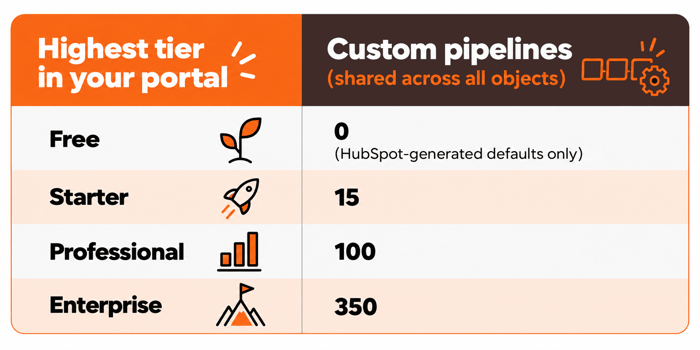
The hub requirements are gone too, so every hub can now create deal and ticket pipelines.
And “shared” really means shared. That limit isn’t just for deals and tickets. It covers every HubSpot object that has pipelines: leads, orders, projects, courses, etc. Every custom pipeline you build, on any object, counts toward the same total. The one freebie: each object’s default pipeline doesn’t count. A few objects still have their own tier requirements, too: lead pipelines need Professional or Enterprise, and custom object pipelines need Enterprise (HubSpot’s knowledge base).
😬 The Awkward Conversation We No Longer Have to Have
Here's a scenario we've lived sooooo many times. A client buys Marketing Hub Professional and connects it to Salesforce. Each Salesforce opportunity record type syncs into HubSpot as its own deal pipeline. Suddenly a marketing-only customer needs a Sales Hub seat they'll never, ever use, just to unlock enough pipelines.
"If they're integrating Salesforce, they needed to buy a sales seat, even if they weren't doing sales, just to be able to create the necessary number of pipelines," Kirill Ougarov, our RevOps Director explained.
Our CEO Rebecca Gonzalez confirmed the pain. On marketing-only deals she'd sometimes forget to ask about pipelines, "and frequently I've had to buy extra seats later."
Welp. Not anymore.
How We Found It
While connecting a client's Salesforce sandbox, six Salesforce pipelines popped up and Kirill braced himself for the extra-seat talk. Then he checked the limits page.
"I see I'm on the limit, like 350. I'm like, what? Hold on. Is this a sandbox limit?"
It wasn't. The live account had the new limits too, and a dig through the update history confirmed it. His verdict: "Deals and tickets are basically just another object, at least as far as pipelines are concerned."
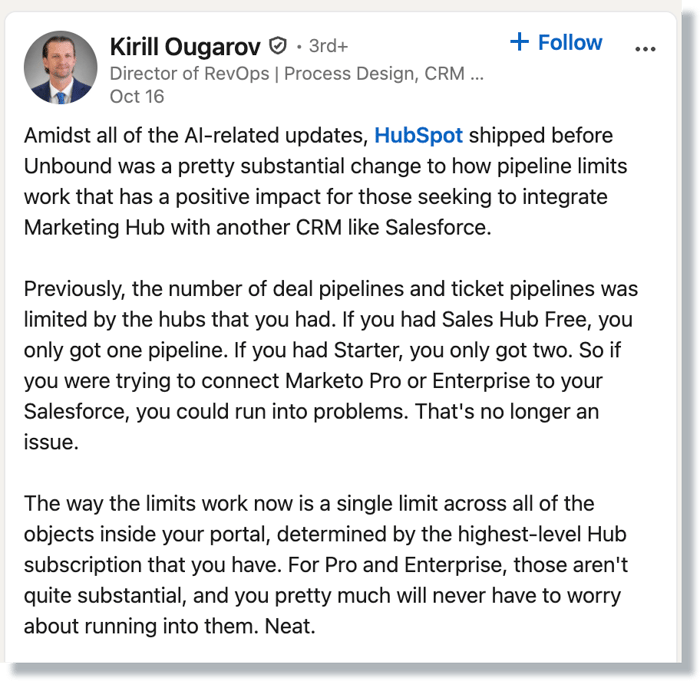
He was excited enough to share it on LinkedIn, which, for a RevOps guy, is basically a parade:
🙃 But Let's Talk Fine Print Why Is HubSpot Doing This
- Just because you can doesn't mean you should. Maggie Stevens at Alterra Solutions welcomed the change but warned that more available pipelines doesn't mean you need more. Her rule, "Pipeline = Process," is one we'd happily tattoo on every portal. Same stages, different region or product? That's a property, not a pipeline.
- Your pricing model matters. Per HubSpot's knowledge base, portals on Flexible Seats & Credits pricing get 350 custom pipelines at Professional, not 100. The count also excludes each object's default pipeline.
- Not all pipelines are created equal. Leads in a custom pipeline don't get default lead-stage automation, something HubSpot Community users have grumbled about for a while.
Why Is HubSpot Doing This
HubSpot didn’t say. But let's look across the Atlantic.
Since October 1, new HubSpot customers in Europe, the Middle East and Africa (EMEA) don’t buy separate hubs at all. They buy one edition (Starter, Professional or Enterprise), pay per seat, and fund activity like emails, workflow actions and AI agents from a monthly pot of credits. Existing customers, and everyone outside EMEA, stay on current pricing for now (Hacking Demand’s breakdown).
Now connect the dots. When there are no separate hubs, hub-based pipeline limits stop making sense. Remember that Flexible Seats & Credits portals already get 350 pipelines on Professional. This update looks a lot like groundwork.
"Eventually, there's just going to be HubSpot, and then you just pay for the usage beyond that. That seems to be the direction they're rolling in."
⏰ Why You Need a HubSpot Audit Right Now
HubSpot's rules just changed. That means the portal you built under the old rules is probably not the best ROI in at least one expensive way.
- HubSpot is shipping faster than anyone can keep up. UNBOUND unleashed a flood of AI agents and features, and one batch of release notes we reviewed ran seven pages. We go through every update as a team each week, and we still almost missed this one. Your busy in-house admin doesn't stand a chance.
- The pricing rulebook is being rewritten. Shared pipeline limits, Flexible Seats & Credits pricing, swapping unused seats for credits. What you bought last year may not match what you need, or what you should be paying, today.
- AI is only as smart as your portal. Breeze now lives in Slack, helps build quote templates and sorts support tickets by topic. Feed it messy properties and duplicate pipelines, and it'll hand you confidently wrong answers faster than ever.
- Features are moving under your feet. Standalone case studies are being folded into a blog template, and new email-tracking consent settings are on the way. What worked six months ago may not work the same way now.
- Renewal season is here. Q4 is when budgets get locked. Find the waste before you sign up for another year of it.
Our HubSpot Portal Audit finds the seats you don't need, the pipelines you shouldn't have, and the fixes that actually matter. Let's take a look.