Monica Cavanagh
For decades B2B companies debated whether pricing belonged on their websites. Would it scare prospects away? Complicate sales conversations? Give competitors an advantage? Those questions made sense in a world where buyers mainly used demos, referrals, and sales calls to compare solutions. That world no longer exists.
Now we are seeing that a significant portion of B2B discovery happens before any human ever sees your site. Roughly a quarter of B2B buyers now use generative AI tools instead of traditional search to research vendors and evaluate solutions. 68% of B2B decision-makers use AI tools rather than Google/search engines as their first step in their research process. And AI search traffic has exploded (up more than 500 percent year over year) making AI both a discovery channel and a referral source.
Those numbers matter because AI systems do one thing first and foremost: they look for direct answers to user intent. When the buyer’s intent includes cost, the engines scan your site for pricing signals.
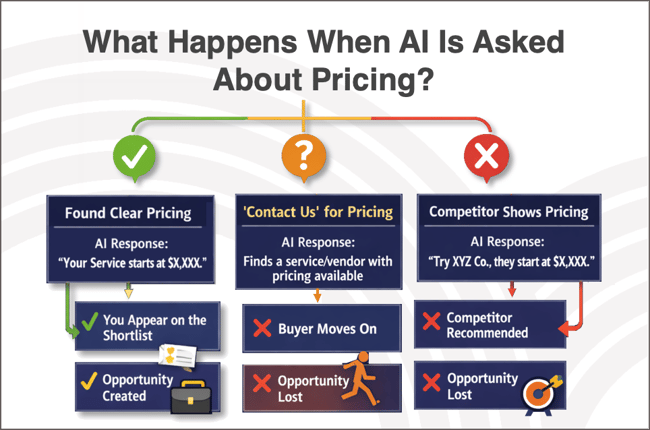
If they find nothing, here’s what typically happens:
- The model answers with vague guidance and tells the buyer to contact you.
- Your brand is absent from the shortlist altogether.
- The model cites a competitor with clear pricing instead.
AI Interprets What It Can See, Not What You Intend
AI models are trained to give complete, accurate, helpful responses. They do not infer pricing from indirect cues or hope sales will fill in the gaps. Merely linking to a “contact for pricing” form counts as no pricing at all in the eyes of the model. What it can crawl (structured numbers, ranges, tiers, starting minimums) becomes the evidence AI uses to answer cost queries.
This phenomenon aligns with what marketing thinkers like Christopher Penn are pointing out: if your site lacks real pricing, it cannot satisfy a core piece of buyer intent that AI tools are trying to fulfill. You don’t get cited. You don’t make the shortlist. Over time, that means less organic discovery and fewer opportunities to influence demand early.
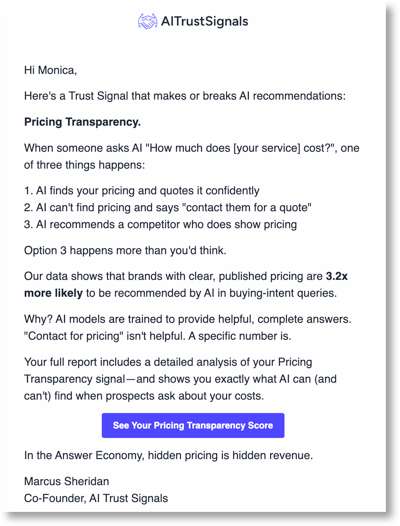
At the same time, what AI Trust Signals Co-Founder Marcus Sheridan’s said in a recent email puts a fine point on this trend: In the “Answer Economy,” when someone asks AI how much your service costs, the model either quotes a number, punts back to you, or recommends someone else. Data shows brands with clear, published pricing are significantly more likely to be recommended in buying-intent AI answers. That makes pricing not just transparency but a trust and visibility signal in its own right.
“Custom” Pricing Can Still Be Public
Most B2B services are not simple, fixed-price products. And that's fine. You don't need one flat price to be transparent. You need clear, structured information.
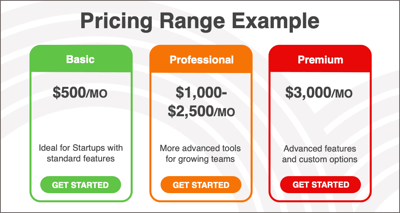
Instead of hiding pricing, you can:
- Share starting prices or pricing ranges
- Set minimum engagement levels
- Show example packages or tiers
- Explain what makes costs go up or down
- Answer common pricing questions on a public page
This does not mean publishing your entire rate card. It means giving buyers, and AI tools, enough real numbers and context to reference when someone asks, “How much does this cost?”
Clear ranges are far better than no numbers at all.
Pricing Transparency Is Now a Competitive Advantage
Public pricing also delivers business benefits outside machine visibility:
- Prospects self-qualify earlier, reducing friction in the funnel.
- Sales cycles shorten because budget alignment happens before first calls.
- Referral partners recommend you with confidence because they can cite numbers.
- Internal teams standardize offerings instead of reinventing solutions with every quote.
Put strategic pricing on your site and engines that depend on it start to treat you differently in their outputs. [Check out our post Show Them the Money: Why We Made Our Pricing Public, And What Happened Next]
Structuring Pricing for AI Discoverability
Publishing pricing is only step one. Structuring it so AI systems can interpret and cite it is where most B2B teams fall short. To help make pricing discoverable and usable in AI-generated answers:
- Use structured data and schema markup where appropriate. It helps AI parse numbers and context more accurately.
- Answer buyer questions directly on public pages with pricing examples and ranges.
- Distinguish between traditional search optimization and AI visibility. Both matter, but AI visibility means being cited by the model as a source of truth.
- Monitor how often and in what context AI platforms reference your brand. That metric matters as much as traditional rankings.
- Treat pricing pages as high-intent destinations and invest in them accordingly.
The Future Is Visibility First
Your website is no longer just persuasive copy for humans. It is training data for machines that influence who gets evaluated, compared, and recommended. In this environment, invisibility is not a traffic problem. It is a structural one.
If you want to understand exactly what to change and how to make your brand more visible to AI systems, you need our resource The AI Visibility Playbook: 10 AEO Tactics for 2026. It breaks down specific tasks and site-level adjustments required to increase citation, recommendation, and inclusion in AI-driven buying journeys.