Monica Cavanagh
HubSpot built the inbound playbook. Now they are moving beyond it. They just renamed their flagship conference from INBOUND to UNBOUND, and their Spring Spotlight product updates tell the same story: HubSpot is rebuilding its platform around how buyers actually behave today.
The original inbound framework assumed buyers start in search, marketers control early-stage education, and websites sit at the center of the journey. That is no longer consistently true. Buyers are asking AI tools for answers, skipping websites in early research, and entering conversations later with stronger intent.
Across marketing, sales, and service, HubSpot is making the same move: from measuring inputs to measuring results, from tracking activity to tying cost to outcomes, and from disconnected tools to unified execution. Here is a look at what is changing and why it matters.
HubSpot's Top 2026 Spring Spotlights
AEO: HubSpot Is Productizing AI Visibility
This may be the most significant update. HubSpot has introduced AEO (Answer Engine Optimization) as a built-in capability, already rolling out as a public beta inside Marketing Hub. This is not a lightweight feature. HubSpot has clearly made a significant investment here, which signals where they believe discovery is going.
The new AEO tool (Content > Search Strategy > AI Visibility) includes:
- Brand visibility percentage across ChatGPT, Gemini, and Perplexity, scoring how often you appear in AI-generated answers (notably, Claude is not currently included despite HubSpot's other integrations with Anthropic)
- Share of Voice comparing your brand mentions against competitors across tracked prompts
- Citation Influence Rate measuring how often AI-cited sources reference your brand
- Citation analysis by content type and source type, including owned versus competitor citations
- AI-generated content recommendations tied to visibility gaps, with reasoning and prompt-level impact
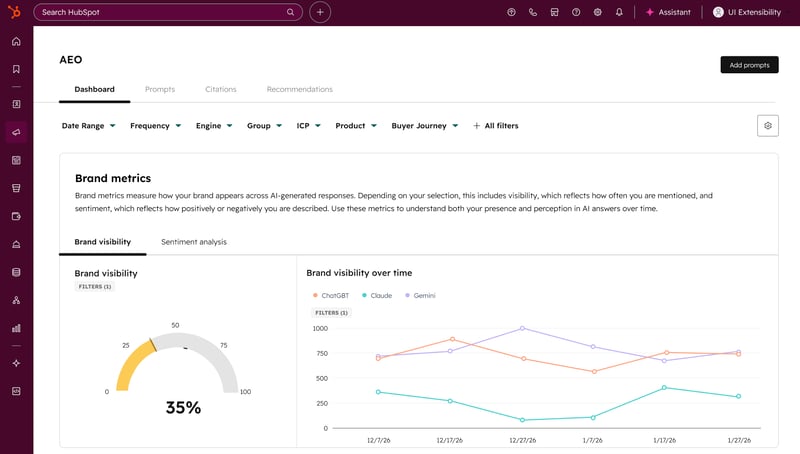
What sets HubSpot's version apart is context. Most AEO tools hand you a visibility report and leave you on your own. HubSpot's AEO auto-generates prompts from your CRM data based on your industries, competitors, and customer segments. Recommendations reflect real business context, and actions execute directly through content, campaigns, and workflows.
This is not just reporting. AEO connects insight directly to execution: from visibility gap to recommendation to content to publish, all inside HubSpot. That closed-loop workflow is the differentiator, not the dashboard.
AEO is included in Marketing Hub Professional (25 prompts/day) and Enterprise (50 prompts/day). A standalone option exists at $50/month, but its value is limited without CRM data. That is also HubSpot's core marketing hook against standalone AEO competitors: other tools do not know your business, but HubSpot already does. Additional capacity comes in packs of 1,000 answers for $20/month.
Prospecting Agent: From Static Lists to Live Buying Signals
HubSpot has rebuilt the Prospecting Agent into a system where you enroll companies and let it monitor them continuously for buying signals: hiring activity, funding events, website engagement, and research intent. It prioritizes accounts automatically and identifies missing contacts within buying groups.
A major addition is integration with Apollo and ZoomInfo to enrich contacts directly. Until now, HubSpot could surface the right companies but left reps hunting for contacts on their own. That gap is now being addressed. And the AI-generated outreach is not bot-speak: HubSpot reports a 90% humanity score on these emails, meaning they read like a real rep wrote them.
The pricing change may matter even more. Previously, teams paid for every email sent and contact enrolled. Now, you pay once when a lead is recommended for outreach. Additional controls include:
- Cap on maximum recommended leads to prevent unexpected charges
- Automatic unenrollment after 30 days if no engagement
- Company enrollment (public beta) for ongoing signal monitoring
- 28-day free trial
Customer Agent: AI Measured by Resolution
Pricing drops from 100 credits per conversation to 50 credits per resolution. You only pay when the agent actually resolves an issue: a content source is shared or action completed with no human handoff within 72 hours, or a lead is qualified.
New deployment controls reduce risk:
- Percentage rollout (start with 10% of conversations)
- Email ignore lists for sensitive accounts
- Training on CSVs and spreadsheets
- Improved human handoff summaries
- Multi-brand support and a 28-day free trial
Additional Spring Spotlight Announcements Worth Knowing About
Beyond the headline AI and prospecting updates, HubSpot also introduced a set of smaller but practical enhancements that tighten execution across sales, service, and campaign management
- Smart Deal Progression, built on Meeting NoteTaker, generates CRM updates and follow-up drafts from call transcripts connected to full deal history
- Breeze Assistant now matches brand settings automatically, with access to analytics, campaign data, and Academy content
- Support Macros combine snippets with multi-step workflow actions inside the help desk — up to 500 per portal
- Customer Success Rooms give customers and CSMs a shared onboarding space with configurable notifications across email, Slack, or Teams
- MCP Compatibility lets third-party AI tools connect to HubSpot data through the Model Context Protocol
- Campaigns can now trigger workflows directly, and meeting scheduling links tie to campaigns for better attribution
Where Does Your Brand Stand in AI Right Now?
 Of all the updates here, AEO demands attention first because it addresses something most teams have never measured: whether their brand shows up when buyers ask AI for answers. HubSpot is building the tools, but the tools only help if you know where you stand today.
That is exactly what we covered in our recent live session, What AI Knows About Your Brand: AEO Expert + Early Client Results, this Friday, April 17. We walked through how AI discovery works, what early adopters are testing, and where most companies were getting this wrong. It's a power-packed 30 minutes with 30 minutes of listener questions. Worth a listen - [Get the Recording].