 Orange Marketing
.png)
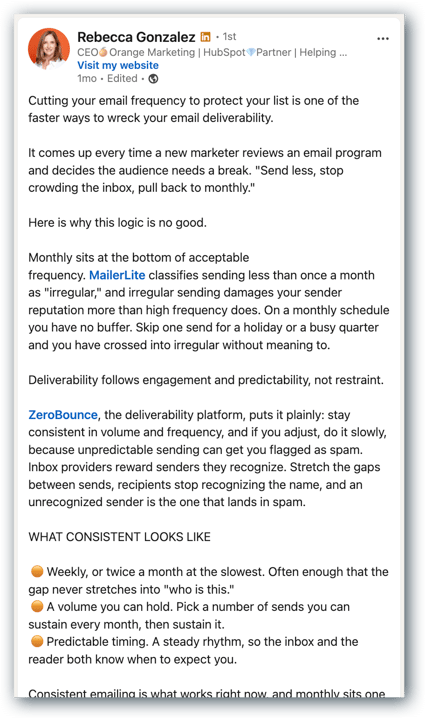 It's one of the most common conversations in email marketing: someone reviews performance, decides the audience needs a break, and proposes pulling frequency back to monthly 'to protect the list.'
Our CEO Rebecca Gonzalez posted about this exact scenario on LinkedIn recently, laying out why cutting frequency to "protect" a list is one of the fastest ways to wreck deliverability.
Monthly, she pointed out, sits at the bottom of what mailbox providers consider acceptable frequency. Send less often than once a month and you've crossed into "irregular" territory, which damages sender reputation more than high frequency ever does. And monthly gives you zero buffer: skip one send for a holiday or a busy quarter and you've slipped into irregular without ever deciding to.
Rebecca's post struck a nerve, and pulled in some sharp comments. We review them here.
B2B Email Frequency: The Real Rules
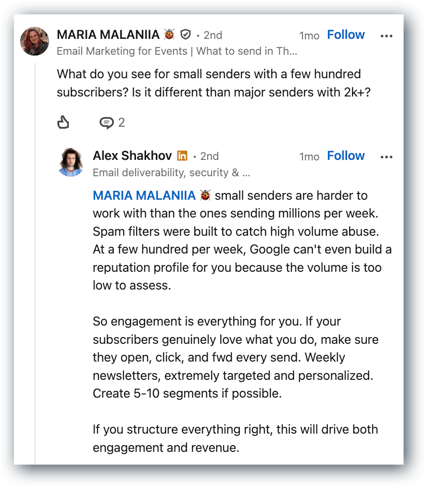
One of the replies took aim at a common assumption: that small lists are inherently safer. Alex Shakhov, who works in email deliverability, pointed out that small senders with only a few hundred subscribers are harder to work with than senders pushing millions of emails a week.
Google can't build a reputation profile for you when you're small, because there simply isn't enough data to assess. That means engagement carries almost all of the weight. If subscribers genuinely open, click, and forward what you send, weekly newsletters that are tightly targeted and segmented, Alex suggests 5–10 segments where possible, will drive both deliverability and revenue.
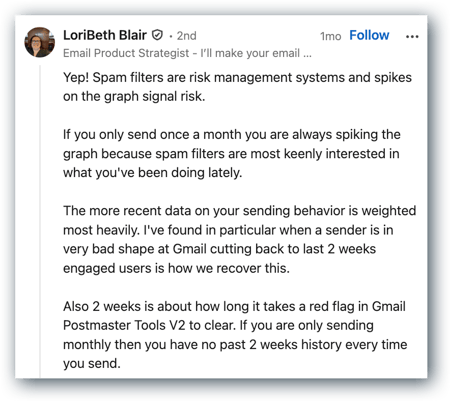
LoriBeth Blair, an email product strategist, took that idea further with a sharper metaphor: spam filters are risk management systems, and spikes on your sending graph signal risk. Send only once a month, and you are, by definition, always spiking the graph, because filters weigh your most recent sending behavior most heavily. She's seen this firsthand with senders in bad shape at Gmail, where cutting back to the last two weeks of engaged users is often how you recover. That two-week window isn't arbitrary, either: it's roughly how long it takes a red flag in Gmail Postmaster Tools V2 to clear. Send monthly, and you never build a full two weeks of history before you send again.
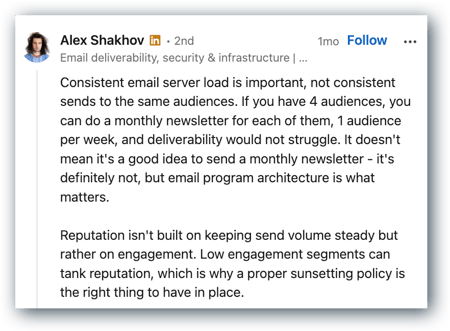
Alex came back with a nuance that's easy to miss: consistency doesn't mean sending to the same audience every single week. What matters is consistent email server load, not consistent sends to the same list. If you have four distinct audiences, you can send each of them monthly, one audience per week, and deliverability holds up fine, because the overall sending pattern stays steady even though no individual audience hears from you weekly.
That doesn't make a monthly newsletter a good idea on its own (it's still not), but it does mean program architecture, how you structure sends across your entire list, is what protects your reputation. Reputation is built on engagement, not volume consistency alone, and low-engagement segments can tank it regardless of how steady your schedule looks. Which is exactly why a real sunset policy for inactive contacts belongs in every program.
Luke Glasner of ZeroBounce, who Rebecca is teaming up with for a live B2B email Q&A August 27th (more on that below), laid out the stakes with math that's hard to argue with.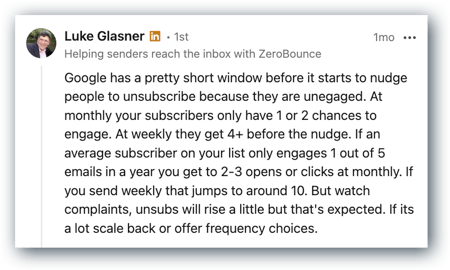
Gmail doesn't wait long to start steering disengaged recipients by not delivering to the inbox. A monthly cadence gives a subscriber maybe one or two shots to engage before that happens; weekly gives them four-plus. Do the math on someone who only opens or clicks one in every five emails they receive: monthly sending nets you 2–3 engagements over a year, weekly gets you close to 10. Yes, complaints and unsubscribes tick up somewhat as frequency rises, but that's a normal tradeoff, not a red flag. Luke's take: keep an eye on those metrics, and if they spike hard, dial back or let subscribers set their own frequency. Monthly shouldn't be the default first move.
And what about list fatigue, the reason B2B email frequency conversations usually start in the first place? Rebecca's answer: check the data first. List fatigue shows up in your open and unsubscribe rates. If those numbers are healthy, the list isn't tired, and there's nothing to fix. Cutting frequency on a hunch, without looking at engagement data, is how a healthy program gets talked into a change that actively hurts it.
Deliverability Rewards Recognition
Every one of the LinkedIn replies points at the same underlying idea: deliverability isn't a reward for caution, it's a reward for being recognizable. Inbox providers, like most trust systems, favor senders they can predict. Slow down, go quiet, or send unevenly, and you stop being a known quantity, whether that's Gmail deciding whether to trust your domain or a subscriber deciding whether they still remember signing up.
That's the exact question a lot of B2B teams are now asking about their email programs more broadly, not just frequency: what's blocking their messages from the inbox, and how much of it is fixable versus structural.
Mark Your Calendar: Rebecca and ZeroBounce Are Going Live
Good news! Rebecca is teaming up with Luke Glasner and ZeroBounce for a live session built directly around that question: Inbox Denied: What's Really Blocking Your B2B Email (and How to Fix It) — Live Q&A with ZeroBounce. They'll get into the mechanics behind everything touched on above: engagement versus volume, sunset policies, warmup, authentication, and the sending patterns that quietly tank reputation before anyone notices. Bring your toughest deliverability questions, this one's a live Q&A.
