Monica Cavanagh
Most email programs do not fail because the copy is weak. They fail because small technical and strategic gaps stack up over time. List decay. Poor segmentation. Weak authentication. A few too many spam complaints.
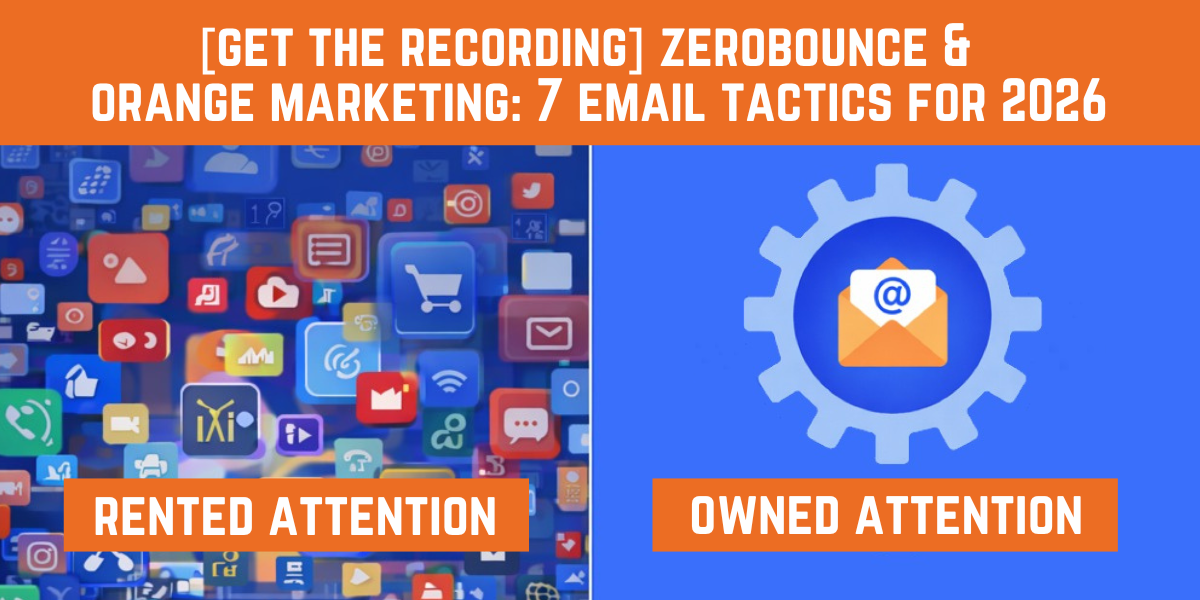
That is why we partnered with ZeroBounce in a recent webinar focusing on what is truly driving deliverability today and what B2B teams can control right now. Our CEO Rebecca Gonzalez joined ZeroBounce COO Brian Minick to break down seven practical tactics. Below is a recap and link to the recording.
Why Email Still Wins in the Age of AI
AI has changed paid media. It has reshaped earned media. It has saturated both.
But email is owned media. You control the list, cadence, segmentation, and messaging. You see engagement signals directly.
That control is exactly why inbox providers evaluate you constantly. Opens, clicks, bounces, and complaints are all signals. Those signals determine whether you remain in the inbox. Our webinar addressed what your best practices need to be in light of this.
7 Email Tactics to Use in 2026
Tactic 1: Clean Data Is the Starting Point
Deliverability begins with data quality.
In B2B, data decays quickly. People change jobs. Companies restructure. Addresses go stale. If you are not actively maintaining your list, you are weakening your sender reputation.
Clean data in practice means:
- Removing hard bounces and invalid emails
- Validating addresses at the point of form submission
- Suppressing likely spam complainers
- Maintaining list hygiene on an ongoing basis
Validation tools prevent bad data from entering your CRM in the first place, which protects long term deliverability.
Tactic 2: Monitor and Protect Your Sender Reputation
Reputation is not theoretical. Inbox providers assign you one. Gmail and Google Workspace represent a significant share of business inboxes, so monitoring tools like Google Postmaster are useful. More importantly, your technical authentication must be correct.
SPF, DKIM, and DMARC are essential. If authentication is misconfigured, your mail can go directly to spam.
The signals that cause the most damage:
- Sending to non existent addresses
- High spam complaint rates
- Users blocking your messages
Unsubscribes are not the issue. Spam complaints are.
Tactic 3: Segmentation Is a Deliverability Strategy
Spray and pray does more than reduce performance. It hurts placement. If large portions of your list stop engaging, inbox providers interpret that as a signal your content is unwanted. Stronger segmentation protects both performance and reputation.
For B2B teams, that includes:
- Suppressing unengaged contacts
- Segmenting by recency and behavioral signals
- Using downloads and page views to inform lists
- Moving from batch sends to behavior based nurture workflows
Not every email must drive a click, especially long form educational content. But engagement overall must remain healthy.
Tactic 4: Simplicity Drives Performance
Complex design does not equal better results. In B2B, your audience scans quickly, often on mobile. Heavy templates and multiple CTAs dilute focus. Every email should have a clear purpose.
We shared a case example of a client with 40,000 contacts and no consistent cadence. After list cleaning and a structured warmup process, simple, focused emails reactivated the database and built a genuinely engaged list.
Clarity outperforms complexity.
Tactic 5: Optimize Subject Lines and Preheaders
Subject lines capture attention. Preheaders reinforce it.
The inbox preview combines both. Forgetting to update the preheader when duplicating emails creates confusion and erodes trust.
For B2B audiences, stronger subject lines tend to be:
- Timely
- Problem focused
- Specific
Clicks are stronger engagement signals than opens. Open rates remain useful for spotting trends or sudden drops.
Tactic 6: Test Inbox Placement Across Providers
Inbox placement is not binary. You may land in inbox at Gmail and spam at Yahoo. Each provider evaluates senders independently.
Unbiased inbox placement testing is critical. Personal test accounts are unreliable because they are influenced by prior behavior. If you are not testing placement, you may not know there is a problem.
Tactic 7: Be Intentional With Timing and Frequency
Timing influences engagement patterns.
A simple B2B rhythm works well:
- Early week for education
- Late week for conversion
We also referenced Jay Schwedelson’s Guru Calendar as a data backed resource for timing decisions.
More importantly, every email needs intent. Every send carries a cost. If you cannot clearly define the purpose of an email, reconsider sending it.
The Webinar Q&A Alone Is Worth Watching
The final 30 minutes of the session became a tactical deep dive. Attendees asked thoughtful, operational questions. We covered:
- Why clicks matter more than opens in long term reputation
- What happens technically when switching ESPs without warming up
- How authentication errors quietly push emails into spam
- Why Gmail and Outlook can treat the same sender differently
- How to repair reputation after placement drops
This was not surface level commentary. It was practical troubleshooting.
Deliverability is cumulative behavior. Once you understand how the system works, you can manage it.
Watch the Recording and Download the Slides
We encourage you to watch the recording, review the examples, and study the Q&A. Then evaluate your own setup with a clearer lens. And as always, if you have any questions, please reach out!
👉 Watch the Recording and Get the Slides