 Monica Cavanagh
Zoom's three-session Marketing Remix event last week delivered great tactics that demand gen and event marketers can use. With speakers from Metadata, Atlassian, and Zoom, the event unpacked what it takes to make virtual events work in an AI-first marketing environment, from building pipelines with lean teams to turning post-event engagement into smarter sales follow-up. Here’s what stood out:
Session 1: Human Connection in an AI-First Era
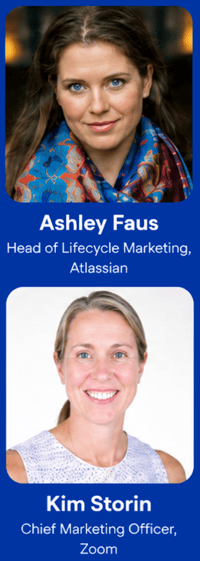 Speakers: Ashley Faus, Head of Lifecycle Marketing, Atlassian; Kim Storin, CMO, Zoom
Kim framed the session around a question most B2B marketers haven't answered yet: now that AI can produce content at scale, what does genuine connection actually look like?
Treat your content like a playground, not a funnel.
Ashley introduced The Playground model as an alternative to the traditional linear funnel. Instead of forcing buyers down an awareness-to-decision path, she described letting them enter and exit as they please, engage in any order, and consume content based on where they actually are. It builds trust, she said, because it acknowledges that buyers move through research on their own terms.
Ashley also flagged a quick win most teams overlook: matching CTAs to actual intent. For an educational webinar, she recommended "Watch the video" or "Explore more resources." For a product deep-dive, "Book office hours" or "Log in and try it." Defaulting to "Learn More," she said, signals that you're not paying attention.
Speaker selection is a trust decision.
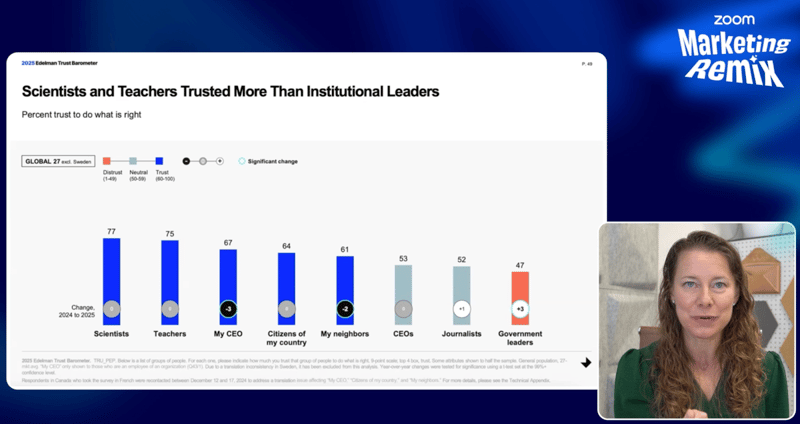
Ashley cited the 2024 Edelman Trust Barometer which found that people trust someone like them more than traditional authority figures. She then walked through three speaker types and how each builds trust differently:
- Subject matter experts: credibility and empathy ("we're in this together")
- Influencers: authenticity and reach ("you're exactly like me")
- Thought leaders: depth of ideas and logic (differentiated on what's next)
Her advice: mix them intentionally instead of defaulting to whoever says yes first.
Go modular, not just snackable.
Concluding the session, Ashley drew a distinction between snackable and modular content. She said most teams break down big assets into smaller clips, but miss the reverse: taking smaller pieces and assembling something new.
A series of customer webinars, for example, can become a long-form narrative. She recommended a few small habits to make content clip-ready from day one: name your nouns throughout, put key stats directly on slides, and reference concepts by name rather than saying "as I mentioned earlier."
Session 2: How Metadata Turned Virtual Events Into Their Biggest Pipeline Driver
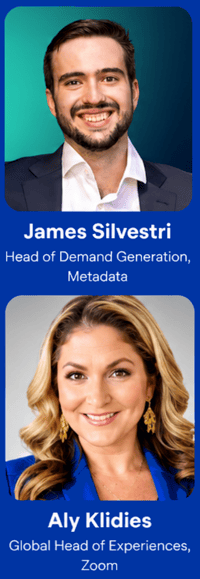 Speakers: James Silvestri, Head of Demand Generation, Metadata; Aly Klidies, Global Head of Experiences, Zoom
James opened this session by sharing that virtual events are now Metadata's number one pipeline driver, despite running a lean demand gen team on a tight budget. His key point: the event itself is just the tip of the iceberg. The real ROI, he said, comes from everything you do with the content afterward: clips, blog posts, transcripts (great for SEO and AI visibility), and repurposed short-form video.
He maintains that if post-event distribution isn't part of your planning, you're leaving most of the value on the table.
They planned a 3-day, 20+ speaker event in one month. And it worked.
In November 2025, Metadata pulled in over 4,000 registrations for an agentic go-to-market event with one month of runway. James walked through how they did it:
- Right platform. They chose Zoom Events for reliability. "We didn't want everything to crash halfway through Day 1."
- Existing network. Speaker recruitment was a blitz of LinkedIn DMs, calls, texts, and emails to anyone doing something interesting with AI in B2B.
- Paid amplification. They built a media kit, then used LinkedIn Thought Leadership Ads to put budget behind it. The speaker's audience came to them, and James noted that one tactic alone drove a significant chunk of registrations.
The results were hard to argue with: 23% of closed deals were influenced by the event, with a 2.5x higher close rate for event-touched pipeline. James mentioned that he texted his CEO 15 minutes into their first session because they had already received their first live demo request. The internal question, he said, quickly shifted from "can we afford this?" to "why aren't we doing this quarterly?"
Bonus tip from James: Email has a much shorter registration tail than most teams expect. Most registrants from any single send convert within 48 hours, so he recommended adjusting your cadence accordingly.
Session 3: Steal Our Post-Event Blueprint
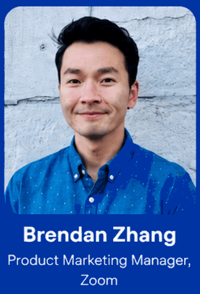 Speaker: Brandan Zhang, Product Marketing Manager, Zoom Events
Brandan opened with a scenario the audience clearly recognized: event ends, team pulls two lists, sends two generic emails, forwards both to SDRs. The SDRs receive a name and a job title with no idea who engaged, who stayed, or what anyone actually cared about. A few meetings happen. Most don't. Everyone concludes the webinar "didn't work."
Brandan's reframe: that's not a webinar problem. That's a signal problem.
He pointed out that attendees handed you 60 minutes of their attention and told you in real time what they care about. Zoom Events captures all of it:
- Engagement scores (0 to 10) built from dwell time and live interaction
- Individual profiles showing time attended and every question asked
- Benchmark comparisons against your past events
- Q&A topic clustering to inform your next webinars
Brandan's recommended approach: sort by engagement score, look at what your highest-engaged attendees asked, and use that as your personalization hook. Not "thanks for attending" but a direct reference to the topic they raised.
He also showed how Zoom's AI content hub generates follow-up emails from the event transcript, segmented by topic, so SDRs receive real behavioral signals instead of a cold list. That one recording, he added, can fuel your content program for the next 90 days.
The Clear Takeaways
The teams winning with virtual events right now treat them as a system:
- Intentional content planning
- Smart speaker selection
- Paid promotion through speaker networks
- Behavioral data activation post-event
Now Make Sure AI Knows You Exist
Running great events is table stakes now. The next question is whether your brand shows up when buyers go looking afterward. And increasingly many of them aren't just Googling anymore, they're asking AI.
We dug into exactly that in our recent session on AEO and HubSpot's new prompt visibility tools, with Orange Marketing CEO Rebecca Gonzalez sharing what's working in real client work and RevOps Director Kirill Ougarov demoing how to track where your brand shows up in AI search. Watch the recording here.
