 Monica Cavanagh
When our CEO Rebecca Gonzalez posted about websites being held hostage on LinkedIn, she expected some nods of recognition. What she got was an outpouring. Marketing and sales professionals from across the industry came flooding in with their own horror stories, tales of clients pushed to the brink, and "I have seen this a thousand times" energy.
The post hit a nerve because this is not ancient history. Websites are being held hostage right now, to real companies, with real consequences.
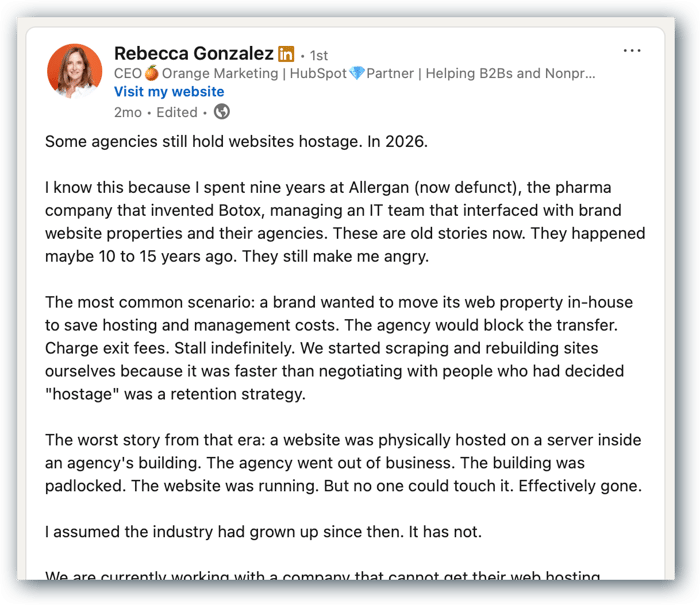
The Problem Has Not Gone Away
Rebecca's post drew on nine years she spent at Allergan (the pharma company behind Botox), managing an IT team that interfaced with brand website properties and their agencies. At the time, stories of agencies blocking website transfers, charging exit fees, and delaying moves in-house felt like relics of a less professional era. Sadly, they are not relics.
Right now, Orange Marketing is working with a client who cannot get their web hosting vendor to add a HubSpot tracking code to their site. The client does not have access to their own DNS records. The vendor controls it. The company believes they own their domain. Technically, they do. Functionally? Not so much.
That is not a technical inconvenience. That is a business risk.
LinkedIn Agreed. Loudly.
Rebecca's LinkedIn comments section lit up fast:
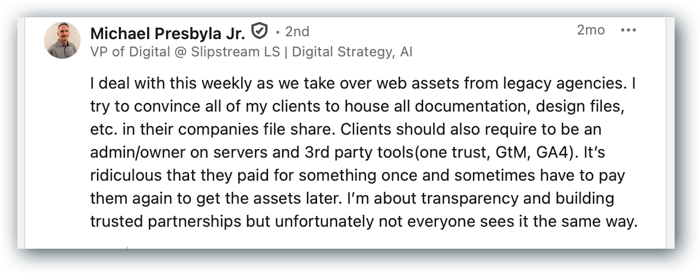
Michael Presbyla Jr., VP of Digital at Slipstream LS, confirmed he deals with this issue weekly when his team takes over web assets from legacy agencies.
His advice to clients: require admin and owner access to every server and third-party tool, including OneTrust, Google Tag Manager, and GA4, from day one. His frustration was plain. Clients sometimes end up paying twice for assets they already paid for once.
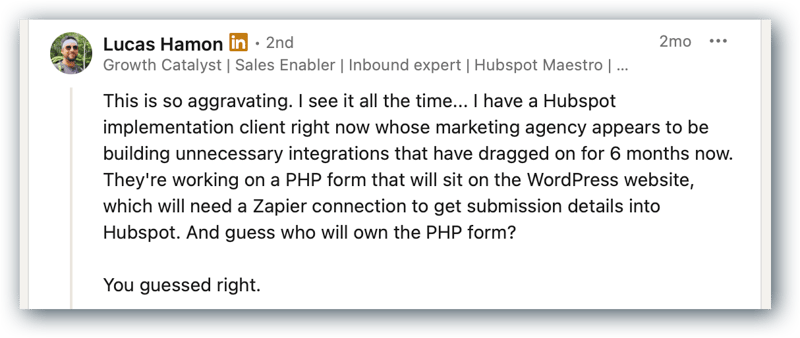
Lucas Hamon, a self proclaimed HubSpot Maestro and growth consultant, described an active client situation where a marketing agency had been building unnecessary integrations for six months. A custom PHP form on a WordPress site, routing through Zapier, to get submissions into HubSpot. A problem HubSpot's native form embed solves in about four minutes. And ownership of that PHP form? The agency's. Of course.
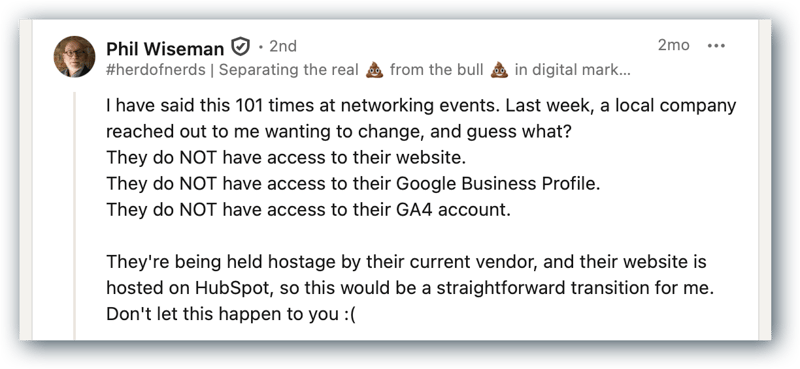
Phil Wiseman shared a story from a recent networking event: a local company reached out to switch providers and discovered they had no access to their own website, no access to their Google Business Profile, and no access to their GA4 account.
Their site was hosted on HubSpot, which would have made their planned transition clean. But they were completely locked out by the current vendor.
An Example of How Bad Things Can Get
Back in Rebecca's Allergan days, her team eventually started scraping and rebuilding sites themselves because negotiating with agencies that had decided "hostage" was a retention strategy was slower and more painful than starting over.
The worst story Rebecca saw back then still stings. A website was physically hosted on a server inside an agency's building. The agency went out of business. The building was padlocked. The website was still running, but no one could touch it. It was effectively gone.
In 2026, the equivalent looks like clients who do not own their DNS, agencies burying tracking access inside their own master accounts, and vendors who respond to "can you add a line of code?" with six weeks of silence.
Same game. Different decade.
Avoid All This! Answer These 3 Questions:
Rebecca advises checking these three things right now to determine whether you are truly in control of your website:
1. Do you own your own website domain(s)?
Log into your registrar (GoDaddy, Namecheap, Google Domains, etc.). Is your company listed as the registrant? Or is an agency email address in there?
2. Do you have full access to your own DNS records?
Can you log in independently and make changes without calling your vendor first?
3. Can you independently add third-party tracking code to your website?
HubSpot tracking, GA4, LinkedIn Insight Tag. Can you add these yourself, or do you have to submit a request and wait?
- If the answer to any of these is no, that is not a partnership. That is leverage, and it is being used against you.
Why Control Matters
At Orange Marketing, we’ve been spending a lot of time educating B2B marketers on AI tips (AEO/GEO, etc.). And there is one critical component here: AI visibility depends on control. If you cannot update your site, add tracking, or move quickly when search behavior changes, it becomes much harder to show up where your audience is looking.
That is why website ownership matters beyond operations. It affects how fast you can adapt, how credibly you can publish, and how effectively you can compete in AI search.
A Live Session on Standing Out to AI
Join Rebecca Gonzalez and Red Banyan's Evan Nierman on Thursday, July 30th for Earn the Answer: PR + AEO Tactics That Get You Found in AI Search. They will walk through how PR and AEO work together to earn citations and trust in AI-generated answers, along with the specific, practical changes you can start making immediately, assuming you have the keys to your own site. Register for the webinar →
