 Monica Cavanagh
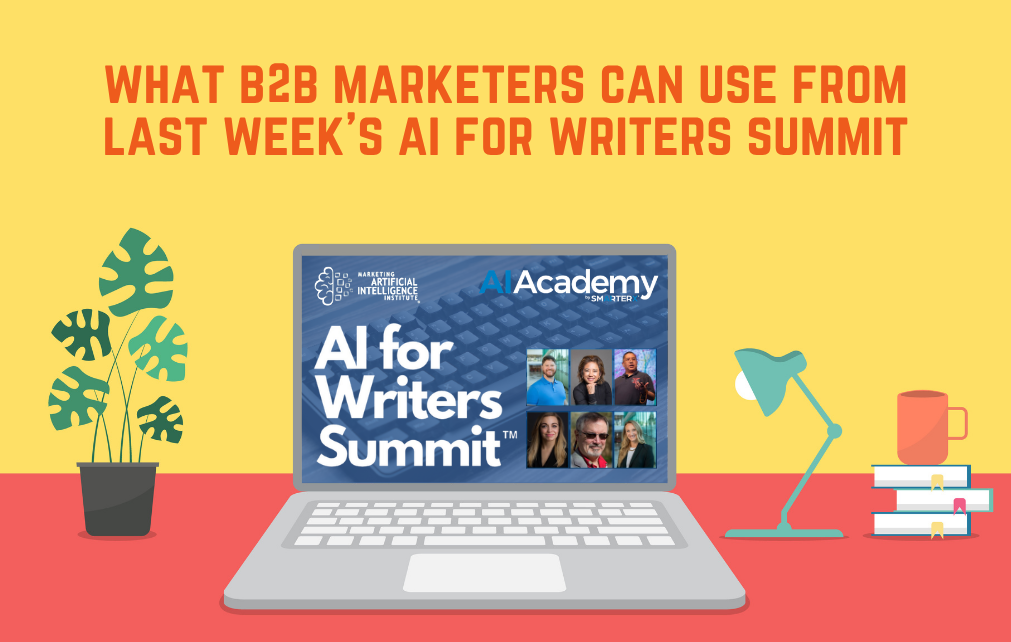
Last week’s virtual AI for Writers Summit from the Marketing AI Institute brought together thousands of marketers from 95+ countries for a focused look at how AI is changing the writing process. That kind of turnout says a lot: content creators, marketers, B2B writers, and editors are paying attention, asking sharper questions, and looking for practical guidance. The summit brought together some great experts - (most worth a LinkedIn follow to keep an eye on their insights).
Here's what stood out from the event.
Your Prompt Isn't the Problem. Your Process Is.
 Taylor Rady (Director of Research, SmarterX) opened her session with this quip: by the time you open a chat window and start typing, you've already given up most of your leverage.
Taylor's session was promoted as pulling: "back the curtain on how she produced the 2026 State of AI for Business Report (a 10,000 word, data-driven research report) by orchestrating multiple AI tools in parallel."
Her approach had nothing to do with clever prompting. It had everything to do with what she did before she touched a keyboard.
Before writing a word, she:
- Collected reference examples that matched her target format and tone
- Gathered all source documents, including raw survey data, past reports, and brand voice assets
- Used dictation (she recommends Wispr Flow) to brain-dump context she'd normally leave out when typing, since speaking is 3-4x faster and you capture more
- Asked AI to write her project instructions based on that brain dump
- Loaded everything into a custom workspace (Claude, GPT, Gemini, etc.)
Then, and this is the part most people skip, she ran a full dry run on partial dummy data two weeks before the real data was ready. She tested every prompt, found every snag, and built a step-by-step SOP she could follow when it counted.
The takeaway for B2B content teams: if you're producing white papers, research reports, or long-form content, the real investment isn't in writing. It's in architecture. Build your system before you start the clock.
Fast Is Easy. Trustworthy Is the Hard Part.
Once you have your draft, you have a different problem: is all of it true? AI can hallucinate. It can recycle outdated statistics. It can attach a real citation to the wrong claim. Any of these can end up in your published content and hurt your credibility.
Taylor outlined three verification methods she's using in practice:
- Inline citations from AI search tools. When you use Gemini or ChatGPT with web search enabled, outputs come with footnotes linking back to sources. Click through. Verify the stat exists on that page. Check that the source is credible. Confirm the sentence isn't twisting the original claim. This is your first line of defense for any AI-generated content that includes statistics or external references.
- NotebookLM for source grounding. Upload your own pre-vetted sources, including interview transcripts, internal research, and client data. NotebookLM will cite the exact paragraph in your own materials. The key difference from inline citations: this checks claims against sources you already trust, not sources AI found on its own. Both are useful; they serve different jobs.
- Gemini side panel in Google Sheets. For data-driven reports specifically, this is where she cross-checks numbers. You can prompt it to build pivot tables and verify statistics directly against your source spreadsheet, without rebuilding every table by hand. It's source grounding for your own data.
Taylor conceded that verification takes more time than it used to. The bottleneck has moved from production to accuracy-checking. She advised that you should build that time into your project timeline from day one, not as an afterthought.
Your Job Title Just Changed.
 Taylor, along with fellow panelists Liza Adams, a content strategist and AI adoption advocate, and Christopher S. Penn, co-founder and Chief Data Scientist at Trust Insights, all said some version of the same thing: AI didn't eliminate the writer's job. It changed what it looks like.
The craft is still there. Writing is rewriting. The first draft was never the work, whether you wrote it yourself or AI did. The work is the editing, the judgment calls, deciding what stays and what goes, what serves the reader versus what just sounds smart.
What really changes is where your time goes. Less time drafting sentences. More time deciding whether your narrative is framing the data correctly. Less time formatting tables. More time asking whether you're drawing the right conclusions from the data.
Liza put it plainly: AI has made her more curious, but not less busy. She said she is connecting dots she never had time to connect before, with that curiosity leading her down many rabbit holes. The panelists agreed that AI has not necessarily reduced their hours. Instead, it has changed where their attention goes.
For B2B marketers specifically, that distinction between time spent and value created matters a lot. AI cannot sit across from a subject-matter expert and conduct a real interview. It cannot bring the institutional knowledge you have about a specific market segment. It cannot make the call on which data point is going to resonate with a CFO versus a VP of Marketing.
That intuition about the content's audience, industry context, and editorial instinct is what makes B2B content useful. It also matters more now because ordinary writing (and even "slop") is everywhere. When every company can publish something polished enough, the bar is no longer “clear and competent.” The real challenge is creating work with enough specificity, perspective, and usefulness to stand out.
One More Thing Worth Your Attention
There's a related problem that didn't come up at the AI for Writers Summit, but it's one every B2B marketer using these tools should be thinking about.
You can build a better content process. You can produce white papers and reports faster, verify them more rigorously, and free up time for higher-value work. But all of that only matters if your content is showing up where your buyers are looking.
And increasingly, they're not starting with Google. They're asking Claude, ChatGPT, and Perplexity to shortlist vendors for them. If your brand isn't showing up in those answers, it doesn't matter how good your content is. You're content is never served up.
That's exactly what we're covering in our live session this Friday, May 15: The AEO Playbook: What's Working + HubSpot's New Prompt Visibility Tools. Our CEO Rebecca Gonzalez will share what's working in AEO right now based on real client work and field testing. And our RevOps Director Kirill Ougarov will demo HubSpot's brand new prompt visibility tools, so you can see how to start tracking where your brand shows up, and where it doesn't, inside AI-driven search.
There will also be a live 30-minute Q&A, so if you've been trying to make a game plan on showing up in AI search, here is a terrific start: Register here to save your spot.
