 Monica Cavanagh
Earlier this week, a company called us after migrating tens of thousands of contacts from MailChimp to HubSpot back in December. The week after the import, they emailed their entire list straight out of HubSpot. And unfortunately, they landed in email purgatory almost immediately, leaving them fighting deliverability problems for six months.
Our CEO Rebecca Gonzalez ended up posting about it on LinkedIn, feeling pretty bad for the client and hoping to warn others away from a similar fate.
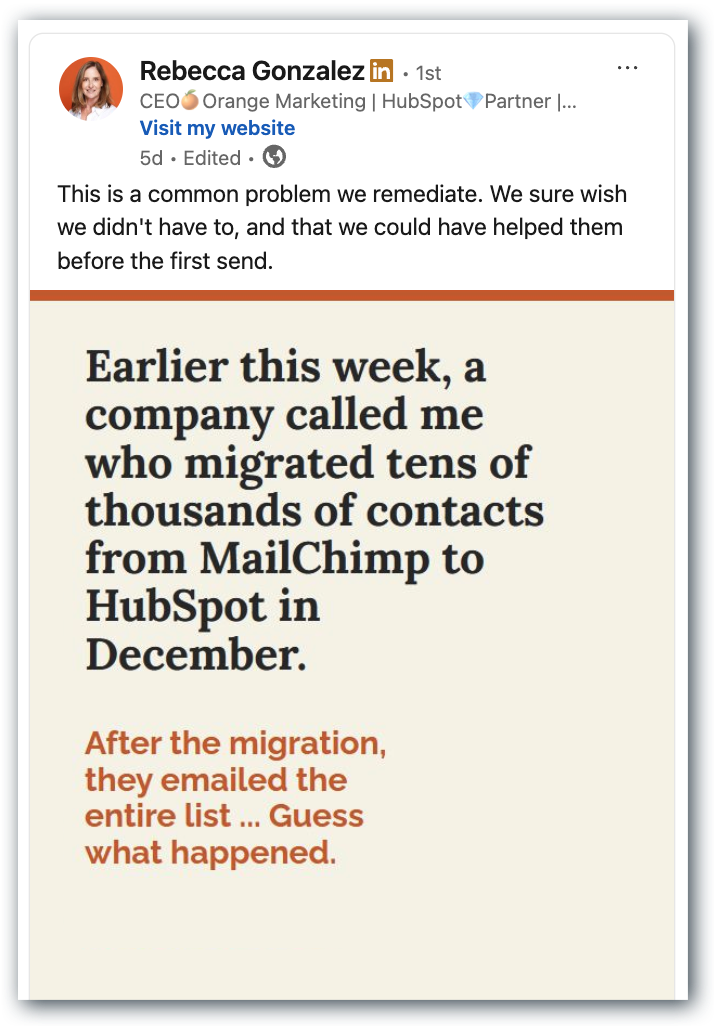
The post sparked quite a bit of discussion in the comments, with marketers, agency folks, and deliverability experts weighing in on what this team missed and how to avoid the same misfortune. So we pulled the best questions out of that thread and answered them here, in Q&A format, the way we wish someone had answered them for this client before that first send 🫤.
Email Deliverability Questions Worth Answering
Q: What causes a company to end up in "email purgatory" after a migration?
Almost always, it's the same root cause: a new sending setup with zero history gets treated to a full-volume blast right away. Mailbox providers don't know your new ESP or IP yet, so they treat every send as guilty until proven safe. Add in a sudden infrastructure change, a sudden volume spike, or a sudden content change, and you've triggered the exact pattern spam filters are built to catch, because that's also how compromised accounts behave. The one rule of email fight club, "no sudden moves."
Q: What's the one step everyone skips?
Email list cleansing before the first send. Tools like ZeroBounce exist specifically for this: validating a list before it touches your new ESP, not after deliverability has already tanked. In the case Rebecca shared, no cleansing was run before that first email went out to tens of thousands of contacts.
Q: What about warmup, is that really necessary?
Yes, and it's the second most-skipped step. Warmup means slowly ramping sending volume over weeks or months so mailbox providers can build trust in your new domain or IP. There's no shortcut around it. A new ESP has no sending history, so the only way to prove you're a legitimate sender is to build that proof over time. Skipping straight to a full-list send is the single fastest way to get flagged.
Q: We've heard DNS setup matters too. How much?
A LOT, and it's skipped so often because it feels invisible...until it breaks.
Proper SPF, DKIM, and DMARC configuration is foundational to deliverability. Without it, mailbox providers have no way to verify your emails are legitimately coming from you. If a migration doesn't include a DNS audit, that's a gap worth closing before any bulk sending resumes.
Q: Does it matter if we test our email content and formatting?
It can. Formatting issues, broken rendering, or content that trips spam filters (excessive links, sketchy phrasing, image-heavy layouts with little text) can compound an already fragile sending reputation. It's worth testing content and formatting for deliverability specifically, not just how it looks in your inbox.
Q: Should we be sending high-volume campaigns from our main domain?
It depends. For high-volume senders, it is best to set up a subdomain for mass marketing sends rather than your root domain, and if you're doing high volume prospecting or cold outreach, consider a third-party tool separate from your main CRM. If prospecting is successful, port those contacts into your CRM. Setting up a subdomain is an up-front investment, but it isolates your sender reputation, so if something does go wrong, it doesn't drag your whole domain's credibility down with it. Even little old Orange Marketing sends it's email newsletter from hello@go.orangemarketing.com - better to be safe then sorry.
Q: Is there anything we should do before the migration even happens, not just after?
Yes, this step is often missed because it occurs before anyone thinks about deliverability. Consider notifying your customer list before you migrate: a short heads-up that you're changing providers, along with a note your contacts can forward to their IT teams to update IP whitelisting. A simple email sequence around this can prevent a surprising number of downstream issues, especially in B2B where a lot of recipients sit behind corporate spam filtering.
Q: How long does it typically take to recover once deliverability breaks?
Longer than people expect, and definitely not something that resolves itself just by waiting. Generally, it can be recovered in two to three months.
In the case Rebecca shared, it's been six months and counting. Recovery usually means going back to basics: pausing high-volume sends, cleaning the list retroactively, rebuilding warmup from scratch, and being deliberate, sometimes painstakingly so, about explaining the "no sudden moves" plan to everyone touching that data going forward.
Q: Is this really an IT problem, a marketing problem, or both?
Both, which is exactly why problems arise. Marketing teams often don't loop in IT, and IT teams often aren't thinking about sender reputation.
We treat every migration as an IT-level project with a defined process, because "sometimes people don't know what good looks like" until they've lived through the alternative. A little structure up front is dramatically cheaper than six months of remediation.
The Bigger Pattern Here
What happened to our client isn't really an email story. It's a "we didn't plan for how the internet evaluates trust" story. Deliverability, sender reputation, spam filters: these are all systems deciding behind-the-scenes whether to believe you're legitimate before a human ever even sees your message.
That same dynamic is playing out right now in a completely different channel: how AI search engines decide whether to trust, cite, and surface your brand.
Just like an ESP with no sending history gets treated as guilty until proven safe, a brand with no structured signals, no fresh content, and no third-party credibility gets skipped over when AI tools are building an answer. And just like deliverability, waiting it out isn't a strategy. The trust has to be built deliberately, before the moment it matters.
Your Next Move
Join us and PR agency Red Banyan for Earn the Answer: PR + AEO Tactics That Get You Found in AI Search, a live session on how PR and Answer Engine Optimization work together to help B2B brands get found, cited, and trusted by AI tools before someone else's content shapes the narrative for you.
📅 Thursday, July 30, 10AM PT/1PM ET.
Evan will cover the PR moves that matter now: earning credible third-party mentions and shaping your brand's narrative before AI engines form an opinion from someone else's content. We'll cover the AEO mechanics: why freshness matters, why LinkedIn and third-party sources are getting harder to ignore, and what your team can implement this week with structured content, FAQ schema, and stronger trust signals.
