 Monica Cavanagh

AI is no longer a novelty in marketing technology. Nearly every martech platform now claims to be “AI-powered.” But that label alone tells you very little about whether a tool will actually improve your team’s performance, reduce friction in your workflow, or produce measurable results.
In 2026, the real question is not whether a vendor uses AI. The real question is whether that intelligence actually adapts, learns, and improves the way your team works.
Because many tools labeled “AI” are still doing the same things marketing automation has done for years. Just with a shinier label.
Adaptive Learning vs Rule-Based Automation
Real AI should improve over time. It should refine predictions, recommendations, and outputs as new data enters the system. Automation, on the other hand, simply follows rules.
Research from McKinsey & Company’s latest State of AI report reinforces this reality. AI adoption is widespread, but companies only see meaningful performance gains when AI is connected to structured data and integrated into real operational workflows.
In other words: using AI is not the differentiator anymore. Using it in a way that improves performance is.
If you're evaluating an AI-powered martech platform, start with these questions:
- Does the system dynamically retrain its models, or operate on fixed logic?
- How often are the models updated?
- Does the system learn from behavioral signals, or simply execute pre-set workflows?
- Are the outputs predictive and evolving, or just descriptive reports?
If the answers sound like “if X happens, do Y,” you are likely looking at automation.
The real differentiator is whether the system adapts based on your data and improves over time.
Transparency and Training Methodology Matter
Last year, marketers were told to ask vendors what type of AI they used (machine learning, deep learning, natural language processing, etc.). That advice still holds. But it needs to go a step further.
Ask specific questions:
- What AI techniques are actually being used, and why?
- How does the model update itself?
- Is it trained on real-time first-party data, synthetic data, or pre-fed rules?
- How is feedback incorporated into the system?
- What controls exist around data privacy and governance?
And here’s an important practical tip.
If you are only speaking with a sales representative, you may not get a clear technical answer.
Sales teams are excellent at explaining value. But if you want to understand how the system truly works, ask to speak with someone from product or engineering.
Those conversations often reveal whether the platform is delivering adaptive intelligence or simply running advanced automation.
Look for Evolving Insights, Not Static Dashboards
Traditional dashboards tell you what already happened. Real AI should help you determine what happens next.
When evaluating a platform, look for systems that:
- Update predictions as engagement signals change
- Surface next-best actions inside your existing workflow
- Adjust lead scoring dynamically
- Connect insights to lifecycle stages and buying group data
If the intelligence only appears in a separate reporting interface that no one checks regularly, it is unlikely to change behavior.
The most valuable AI today is embedded directly inside your workflow.
Beware Buzzwords Without Substance
Some warning signs have not changed. Be cautious when you see:
- No clear explanation of how the AI works
- No case studies showing measurable improvement
- Product messaging built around buzzwords instead of outcomes
Another growing red flag is what we might call the “AI wrapper.”
Some tools sit on top of generic large language models with little domain adaptation, CRM integration, or governance controls. The output can look impressive at first glance, but without context or structured data behind it, the impact tends to be limited.
If AI cannot access your CRM properties, lifecycle stages, or deal context, it will struggle to produce meaningful business insights.
Peer Validation: A Modern Layer of Due Diligence
It is always smart to consult third-party research. Analyst firms like Gartner and Forrester continue to evaluate vendor capabilities and market positioning.
But in 2026, another signal has become just as valuable: peer validation.
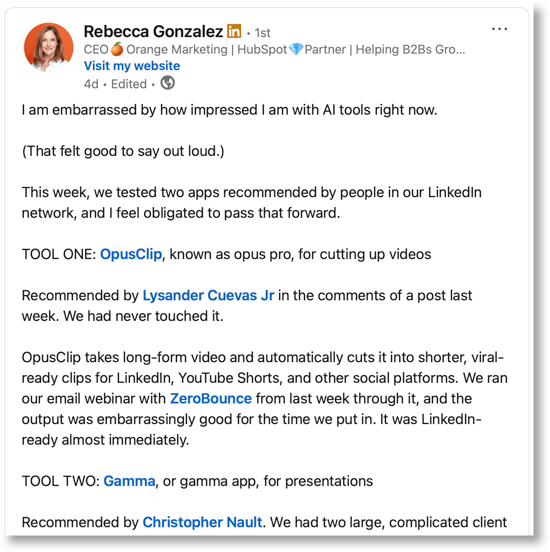 Recently, our CEO Rebecca Gonzalez shared a LinkedIn post about two AI tools recommended to her through her LinkedIn network. These tools did not come from ads or outbound sales messages. They came from fellow marketers.
What mattered was not the “AI-powered” label. What mattered was the outcome.
One tool helped convert a long webinar into short, social-ready clips in minutes. Another transformed complex proposal text into a structured presentation deck almost instantly.
The result was real time savings and clearer communication.
Rebecca’s takeaway was simple: some of the most useful AI tools surface through trusted networks. When people openly share what works and what doesn’t, it becomes much easier to filter out hype.
And that is often where the real signals appear.
What We’re Seeing Across Real B2B Marketing Teams
Rebecca sees hundreds of B2B companies struggle with these questions. Not in theory. In real HubSpot portals. In real sales pipelines. In real email programs where Gmail and Yahoo have raised the bar for authentication and sender reputation.
She sees teams buying AI tools without fixing data structure. Layering automation on messy lifecycle stages. Trying to scale email programs while authentication, segmentation, and sender reputation quietly break underneath.
On LinkedIn, Rebecca regularly shares what our team sees across real B2B environments, from testing new AI tools to fixing HubSpot workflows and helping companies improve email deliverability.
If you're navigating these challenges, we encourage you to connect with Rebecca on LinkedIn. Because in a fast-moving space like this, practitioner insight is often the quickest way to separate real solutions from hype.