 Monica Cavanagh
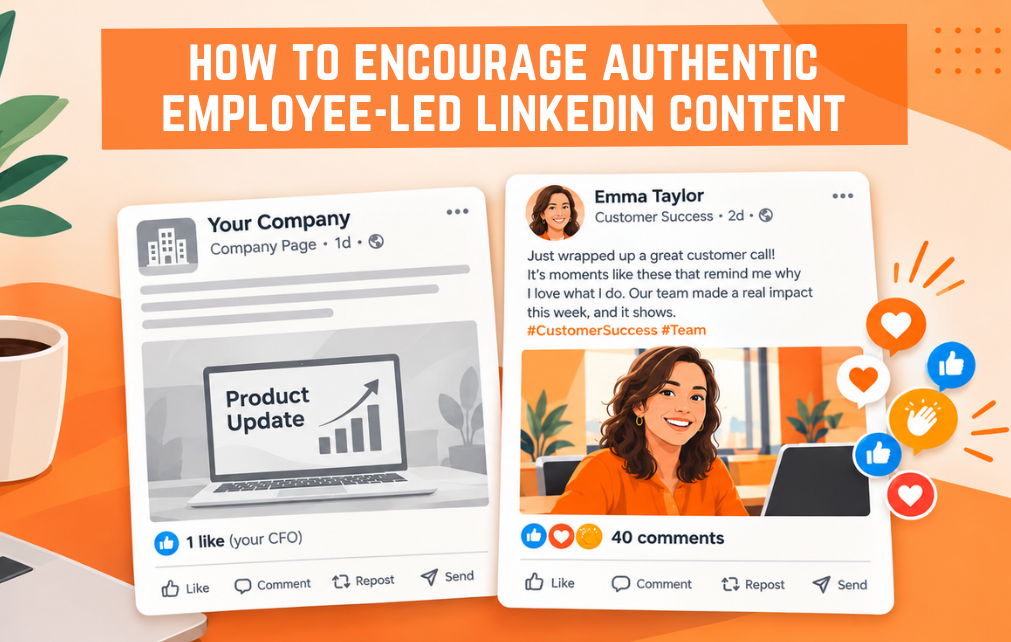
You've been there. You post a thoughtful and engaging product update on your company LinkedIn with an incredible explanatory graphic and then...crickets. Well, maybe a single “like” from your CFO.
Meanwhile, your head of customer success posts a quick story about a client problem she solved on Tuesday, and it pulls 40 comments.
That’s not a fluke. And it means the best marketer at your company probably isn’t in marketing.
The Reach Has Moved to Your People
 LinkedIn has been turning down the volume on brand pages for some time. Now:
- Organic company page posts reach only about 1.6% of their followers.
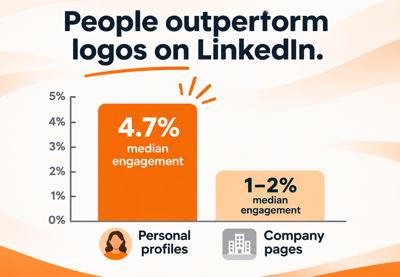
- Median engagement is roughly 4.7% on personal profiles vs. 1% to 2% on company pages.
Translation: people want to hear from people, not logos. And LinkedIn's algorithm enforces that.
Your company page still has a job (more on that below), but the reach lives on personal profiles now.
Don't Worry, The Content Already Exists
It may seem daunting to try and get your people to create content to take advantage of this, but they are already creating great content every day. They just call it “answering emails.” There are three ways to capture existing content:
- Keep an “I’ve said this 143 times” list. When someone repeats an explanation, have them keep a record.
- Mine recorded calls. When a rep untangles a prospect’s problem, have them note the timestamp. That’s a social post draft.
- Search your sent folder. Phrases like “here’s how to” and “the reason this happens” are content gold.
If topics repeatably come up on emails and calls, chances are it's top of mind for your prospects as well and is excellent content fodder.
If they have no time to write, a coordinator, freelancer, or social-savvy teammate can draft social posts from notes and recordings. Then your "expert" can add final touches when they go to post.
Start at the Top
Before you email the whole company a posting calendar, take a page from G2's Jenny Gardynski, Senior Director of Content and Communications. Her advice: don’t hand out the social kit on day one.
Instead, roll it out in stages:
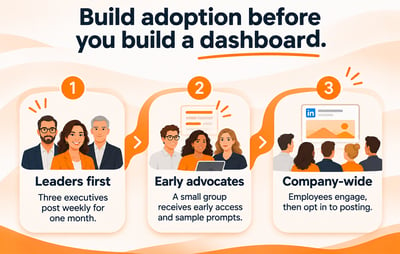
- Leaders first. When a few executives post consistently, employees see that it’s valued and works, leading them to believe in it.
- An early-access group. Try giving a small group a first look at new products and tools, so they can share like real advocates.
- Everyone else, gradually. Ask for others to engage with leadership’s posts, then offer sample posts to anyone who wants to try and post as well.
When you start with these steps, resist the urge to build an ROI dashboard in week one. As Gardynski puts it, “Adoption should be your first metric.” Track two things early: how many people are posting provided posts, and how many of those posts are personalized.
Our take: Get three leaders posting weekly for a month before you ask anyone else to follow suit.
Give a Menu, Not a Script
When you start supplying posts, you'll need to encourage steps to avoid multiple employees from posting the exact same paragraph. As DSMN8 founder Bradley Keenan points out, if every employee shares the same post, you’ve basically built a distribution engine for your company page, which is not rewarded behaviour by LinkedIn. Yet this occurrence is still all too familiar.
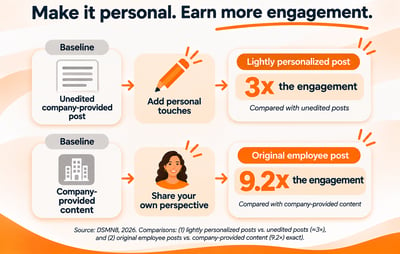 When DSMN8 analyzed 517,374 LinkedIn posts, it found 94.7% of company-provided posts were shared without a single change to copy. That’s a lot of reach left on the table:
- Even minor tweaks earned 3x more engagement than untouched copy.
- Original employee posts earned 9.2x more engagement than employer-provided content.
Gardynski’s fix at G2 lines up with the data: give employees a few key messages and sample posts to choose from, and encourage them to make it their own. Provided copy is a starting point, not the finished product.
Our take: Make one rule non-negotiable - no post goes out unedited. Even one personal line counts.
Use AI to Find Your Voice, Not Replace It
Gardynski taught an AI tool her voice by feeding it her 10 top-performing LinkedIn posts, and G2 is now building a voice tool for employees. Your team should try a version:
- Pull your 10 best posts (or emails, if you’re new to posting).
- Ask an AI tool like Claude to describe your voice in three or four words.
- Draft from a transcript or email, including that voice, the audience, and the one point to make.
- Edit by hand for the best authenticity.
Know What Goes Where
Metricool’s 2026 study found personal profiles spark conversation, while company pages drive distribution. Share link posts also do well on company pages, but personal posts perform best when they stand on their own. So split the work:
- Company page: Reports, webinars, announcements, and links to full resources.
- Personal profiles: Insights, opinions, and stories.
For personal posts, try this formula: one insight, a quick story, and the full resource in the comments. For example: “A client was surprised this week that a ‘profitable’ month showed negative cash flow. Here’s what most people miss…”
Sharing a link anyway? Write your own caption. DSMN8 found that editing the caption on a link share delivered 4.6x more engagement and 6.4x more clicks.
Say What Only You Can Say
Polished, generic employee posts are everywhere, and AI can churn them out all day. What it can’t do is tell your stories. Gardynski says the posts that break through at G2 are rooted in real experience, like:
- How the team built a research report
- A custom demo after a product launch
- Lessons from an event
- A sales tactic that worked
The numbers back this up, too: DSMN8 found original employee posts generated 21x more comments than curated content.
Specificity is your moat. Ask people to answer one question in every post: why does this matter to me?
Make It a System, Not a Burden
None of this works if it depends on inspiration striking. People get busy and forget. You need to encourage that they build it into their week:
- Monday, 10 minutes: Review the “143 times” list and pick one topic per person.
- Draft in batches: One focused hour can produce a month of posts.
- Show up early: Comment on each other’s posts within the first hour.
Start small, stay consistent, and let adoption come before analytics. Once a handful of people are posting regularly, the reach (and the leads) will follow.
Ready to Hand Your Team the Mic?
Your people are the reach engine now, but LinkedIn’s algorithm never sits still. Grab our free guide, The LinkedIn Algorithm Shift: What You Need to Do Now, for the content formats, profile tweaks, and engagement habits that keep your team’s posts in front of the right prospects, without spending hours a day on it.
