 Monica Cavanagh
 On August 27th, our CEO Rebecca Gonzalez sat down live with Luke Glasner, ZeroBounce's Director of Email Deliverability, for Inbox Denied: What's Really Blocking Your B2B Email and How to Fix It. We covered how to tell if your emails are landing in spam, how to fix it if they already are, and how to keep it from happening again.
Doubling Down on Email: An Owned Channel
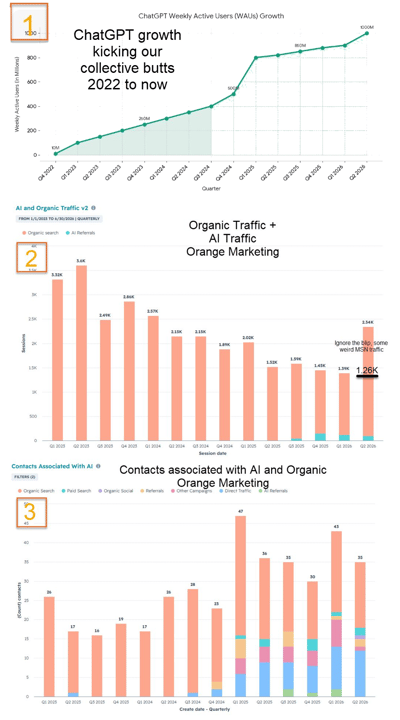 Earlier this year, Rebecca posted an unedited chart on LinkedIn showing what happened to Orange Marketing's own numbers as AI reshaped search:
- Organic and AI-driven traffic fell over 60%, from a Q2 2023 peak of 3.6K sessions a quarter to 1.26K in Q2 2026.
- Leads didn't fall with it. New contacts attributed to Google and AI nearly tripled, climbing from 16 leads in Q3 2023, the worst quarter, to a peak of 43 leads in Q1 2026.
Her read: a lot of what shows up now as "direct" or "campaign" traffic is AI-influenced. Someone sees the brand in an AI answer, then types the URL in directly or fills out a form days later, instead of clicking straight through.
The real lesson here is when you don't own a channel, you don't control it. Google can change its algorithm. AI can change how it summarizes an answer. Either can happen overnight, and all you can do is react after the fact.
That's not a risk email carries. Nobody's algorithm decides whether your email list hears from you. Nobody's AI summary gets between you and a subscriber who already said yes. You own the list, the timing, and the data outright, and no update, model release, or platform decision can take that away from you.
Rebecca cautions here that owning your email channel isn't a nice-to-have anymore. It's the baseline. But owning the channel and running it well are two different things, and that is exactly where most B2B senders lose deliverability without ever seeing it coming. That's where Luke came in, and it's what the rest of this recap is about: how to manage your own email channel.
WATCH THE B2B EMAIL RECORDING 👀
How Do You Know You Have an Email Problem?
There are two ways to check:
- Send test addresses. Mail a handful across providers (e.g. yahoo, hotmail, gmail, outlook emails) and see where they land.
- Run an inbox placement test. A tool like ZeroBounce's seeds real mailboxes at every major ISP and tells you what percentage reaches the inbox. Luke's threshold: once 20 to 30% of a meaningful chunk of your list is landing in spam, fix it.
There's also a tell already sitting in your reporting: Apple Mail Privacy Protection opens. Apple opens every email automatically, so that number should hold roughly steady campaign to campaign. If it suddenly drops, a chunk of that send got junked.
If You Already Have a Problem
If the tests above turn up a real problem, work through it in this order:
- Check spam complaints by ISP, not blended. Your ESP's campaign-level number hides how badly you're doing at any one provider. Sign up for Google Postmaster Tools and Yahoo SenderHub (both free) to see it broken out.
- Do list hygiene. ZeroBounce's data shows roughly 28% of addresses go bad every year, closer to one in three for B2B lists, thanks to layoffs and job-hopping. Re-validate every three months, especially before mailing anyone you haven't touched in a while.
- Run a warm-up if reputation's tanked. Mail your most engaged people first, in small daily batches, and step volume back up over three to five weeks. No sudden jumps. ISPs read a spike as a hijacked account or a spam attack and will junk you on sight, even if it was an honest mistake.
Keeping It From Happening Again
Once you're back in good standing, here's how to stay there:
- Get SPF, DKIM, and DMARC set up properly, and check that they're passing, not just present.
- Skip "no-reply@" addresses entirely, and think twice before putting "marketing" in your sending domain.
- Use subdomains to separate riskier sends (cold outreach) from your main brand domain, so one bad campaign doesn't take your CEO's inbox down with it.
- Be consistent. Luke recommends sending at least twice a month, because once a month is really the floor, and yes, that includes December.
Fix Your Timing, Not Just Your List
 Don't wait for someone on your list to go fully cold before trying to win them back. Luke's approach: find the average subscriber lifespan, subtract a standard deviation, and send the re-engagement play before most people would have churned, not months after. Most brands recover 1 to 5% of "lapsed" subscribers this way. Timed right, that can climb into the teens.
Another tip, when you're A/B testing, skip the vanity metrics. Opens and clicks are noisy, thanks to Apple MPP, bots, and whatever else are messing with your reporting these days. Test structural, repeatable things like offer format, send day, and subject line urgency, then measure by revenue per email or conversion rate.
We promised truth bombs every four minutes in our session, and Luke delivered. If you want the full play-by-play, including the questions we didn't get to live, we turned the whole session into a downloadable PDF Q&A. Grab the recording and downloadable HERE.
