 Monica Cavanagh
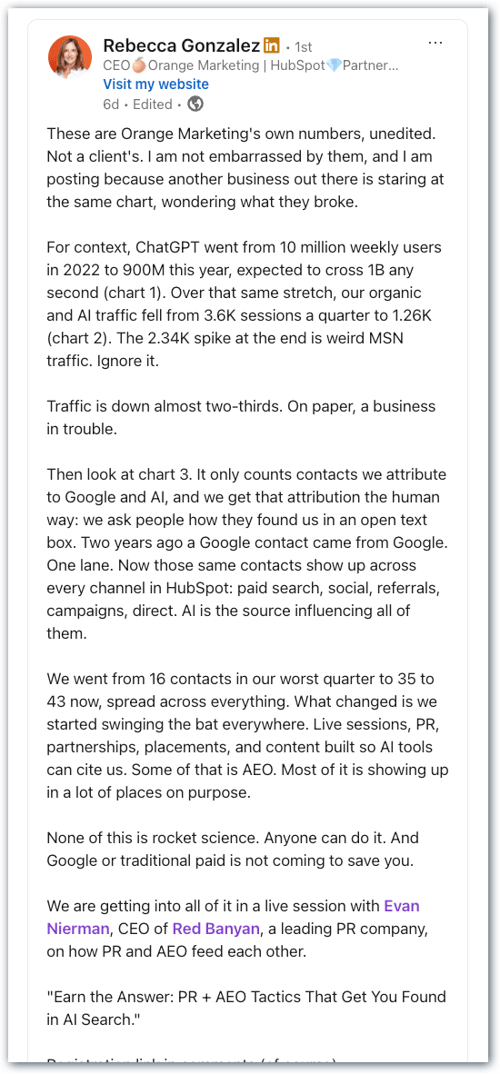
Our web traffic fell by over 60%, and our leads went up anyway. That's not a cute hook. It's what happened to Orange Marketing's own numbers, and our founder and CEO, Rebecca Gonzalez, posted an unedited chart on LinkedIn about this earlier this month.
Six weeks earlier, she'd shared something related: a breakdown from Ahrefs CMO Tim Soulo on how AI search is reshaping who gets found online. It's not proof of what happened at Orange Marketing specifically, but it's the same pattern showing up at a much larger scale, and the two are worth looking at side by side.
What Happened To Our Traffic
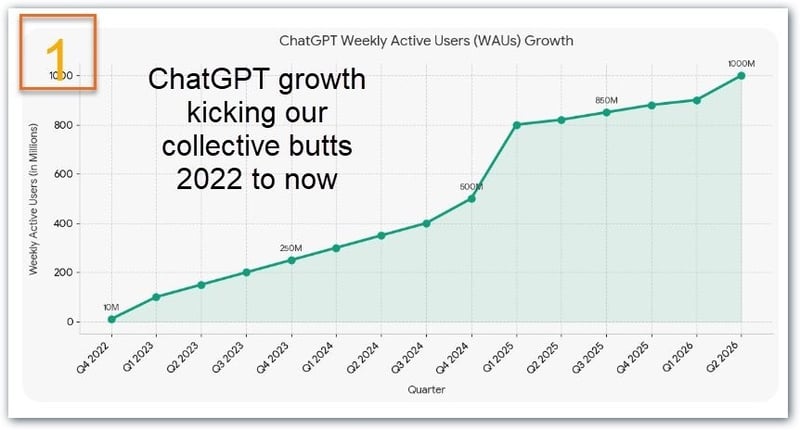
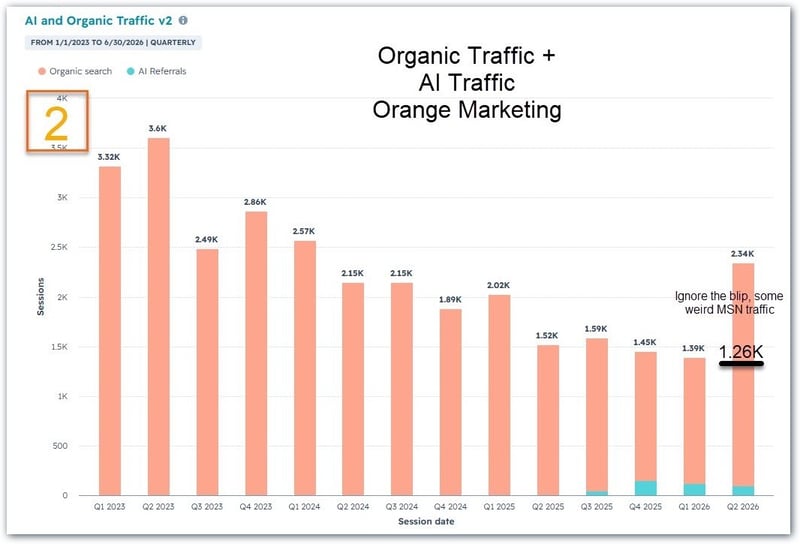
For context: ChatGPT's weekly active users grew from 10 million in Q4 2022 to 1 billion by Q2 2026. Over that same stretch, Orange Marketing's organic and AI driven traffic fell from a Q2 2023 peak of 3.6K sessions in a quarter down to 1.26K in Q2 2026, a drop of over 60%.
As a standalone number, that's the kind of chart that gets a marketing leader an uncomfortable meeting with the CEO.
To be clear, a traffic chart like that could reflect any number of things: an algorithm shift, fewer campaigns running that quarter, a slower news cycle for the industry. We can't isolate AI as the single cause from this chart alone. What we can say is that the drop lines up with the timeline of AI search adoption, and that it didn't come with a matching drop in leads (well, it did to begin with, and then we ran an intervention).
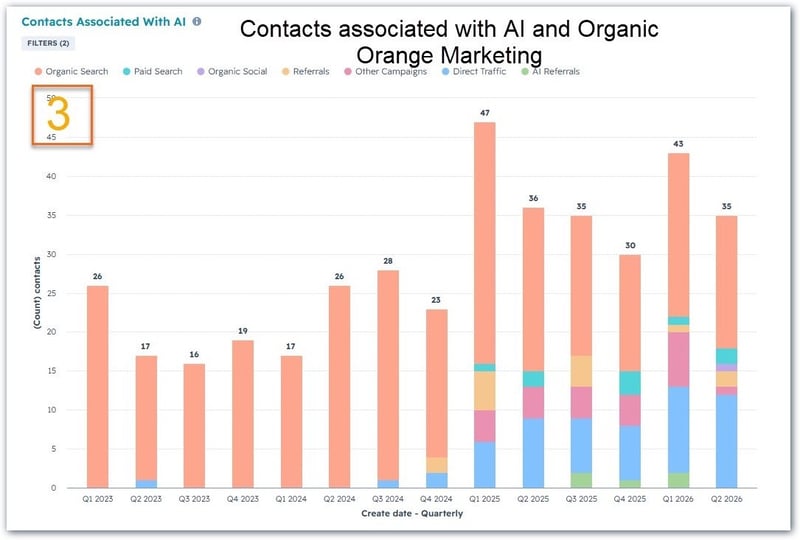
The other half: Over that same stretch, contacts our team attributes to Google and AI didn't fall, they climbed, from 16 in Q3 2023, the worst quarter, up to a peak of 43 in Q1 2026, before settling at 35 the following quarter, still more than double the low point.
That attribution comes from asking new contacts directly, in an open text field, how they found Orange Marketing, not from a tracking pixel. Two years ago, those answers were clean and single channel: a contact who said “Google” showed up as a Google lead, full stop. Today, similar answers show up scattered across paid search, social, referrals, campaigns, and direct.
Reading the Chart Honestly
If you look at the breakdown in the chart, the green sliver labeled “AI Referrals” is small. Most of the recent growth shows up under direct traffic and other campaigns. Rebecca's read is that AI is influencing a lot of that direct and campaign traffic too, someone sees the brand referenced in an AI answer, then types the URL in directly or fills out a form days later, rather than clicking straight through.
That's a plausible read of how AI-influenced discovery tends to behave, but it's an interpretation of open-text answers, not something the data proves outright. Someone who wrote “saw you on LinkedIn” or “typed in your URL” may have had nothing to do with AI at all. Take the specific channel breakdown as a hypothesis Orange Marketing is operating on, not a settled fact.
None of this rules out other explanations either. Sales effort, seasonality, better follow-up, or just asking the attribution question more consistently could all be part of why that number climbed. We're not claiming a clean controlled experiment here, just one company's real numbers over several quarters, alongside a change in strategy that happened over the same stretch.
Rebecca's take: The changes we see happened because the team stopped waiting on any one channel and started showing up everywhere on purpose through:
-
Live sessions (webinars/podcasts)
-
Press releases
-
Partnerships
-
Ad placements
-
Creation and promotion of relevant content
Some of that is textbook AEO/GEO. Most of it is deliberate visibility spread wide.
What The Research Says
Rebecca's framing when she reposted this on LinkedIn is worth carrying into this section: SEO isn't dead, but its old form is struggling, and brand and PR are back in a way she says most marketers underestimate.
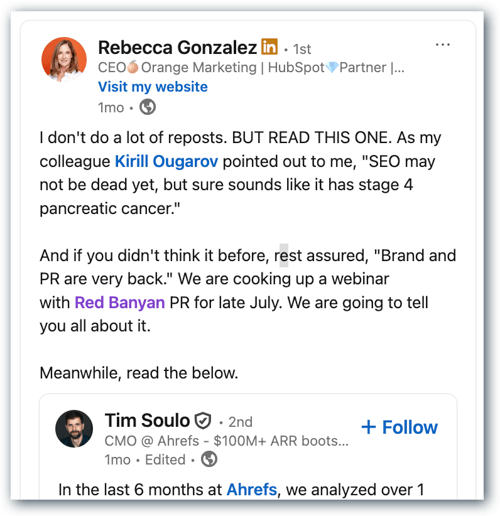
Tim's breakdown, drawn from Ahrefs.com's analysis of a large dataset across 14 studies on AI search citation patterns, points to the same pattern: the signals AI systems trust most are rarely the ones a brand can manufacture on demand.
Two findings stand out. Schema markup, long treated as an AEO essential, showed little measurable effect on citation rates in Ahrefs' data. Meanwhile, YouTube mentions correlated more strongly with AI brand visibility than backlinks, domain rating, or the usual SEO metrics. Layered on top: AI Overviews are reducing clicks to the #1 organic result, and by Ahrefs' account, that gap has been widening.
Worth flagging: these are correlations across Ahrefs' own aggregated dataset, not a controlled study, and they won't apply identically to every industry or query type. A schema markup tweak that does nothing in Ahrefs' data might still matter for a specific niche. Treat the findings as a strong directional signal, not a fixed rule.
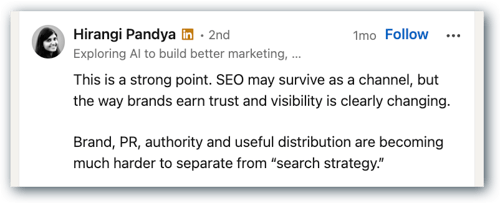
One comment on Rebecca's thread came from Lampros Tech Co-founder Hirangi Pandya, put the implication plainly: SEO may survive as a channel, but the way brands earn trust is clearly changing, and PR, authority, and distribution are becoming much harder to separate from search strategy at all.
Two Signals, Same Direction
Line up the chart and the research and a pattern emerges, though it's a directional one, not a proof. The Ahrefs data suggests why the old playbook might underperform broadly: AI systems appear to weigh third-party, off-site signals over anything a brand publishes about itself.
Orange Marketing's own numbers are consistent with that story, traffic down, leads up, around the same stretch the team leaned harder into PR, partnerships, and content built to be cited. But consistent isn't the same as proven. Neither, on its own, tells you that the exact mix of tactics shared is "the" answer, only that it's a reasonable bet worth testing against whatever you're doing now.
That's precisely the intersection our July 30 live session was built around.
PR + AEO Tactics That Get You Found in AI Search
This Thursday, July 30th at 10 AM PT / 1 PM ET, Rebecca is joining Evan Nierman, Founder and CEO of Red Banyan, for a 30 minute session built to give B2B marketers the full picture: the earned media strategy that builds AI trust, and the hands on execution that turns it into visibility.
 Evan will cover the earned media side: why third party mentions and consistent public trust signals now carry more weight than a polished homepage, and how brands can get ahead of their own story so it's easy for journalists, buyers, and AI platforms alike to find and verify.
 Rebecca will pick up from there with the execution side, why blogs and listicles still carry real weight, how prompt based discovery differs from keyword search, and the structured website changes that move AI visibility.
Attendees will leave with a working sense of which signals are worth building and which ones (like schema markup alone) are not, plus a starting checklist for where PR and AEO should be pulling in the same direction on their own site. Save your spot for the live session →
